
847-873-6741

Can You Get Divorced Without Going to Court?
 Many couples going through divorce in Cook County worry about spending months in Court battles. Fortunately, many divorces in Illinois can be resolved with little or no time in a courtroom. Under Illinois law, couples who agree on the terms of their divorce can often finalize everything through paperwork alone.
This process, known as an uncontested divorce, allows you to end your marriage more quickly and privately than traditional litigation. However, even uncontested divorces have specific requirements under the Illinois Marriage and Dissolution of Marriage Act that must be met.
At The Law Office of Nicholas W. Richardson, P.C., our Barrington, IL divorce attorney understands couples who want to get divorced in 2026, with the minimum amount of mess. We can help you keep your divorce peaceful and straightforward. Call us today.
What Does It Mean to Get Divorced Without Going to Court?
When most people talk about getting divorced without going to Court, they usually mean avoiding unpleasant divorce litigation like you often see on TV. Sometimes, people hope to get divorced without ever going inside a courtroom itself. In some cases, both may be possible.
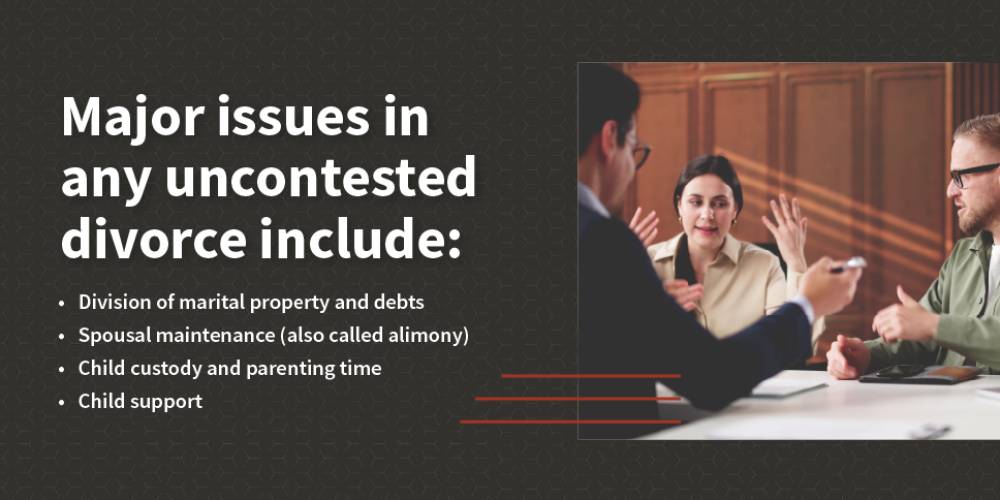
In an uncontested divorce, instead of a Judge hearing arguments from both sides and making decisions for you, you and your spouse work together to settle everything yourselves. The major issues in any divorce include:
-
Division of marital property and debts
-
Spousal maintenance (also called alimony)
-
Child custody and parenting time
-
Child support
When both spouses agree on all of these matters, the divorce becomes uncontested.
In Cook County, an uncontested divorce still requires filing paperwork with the Court and getting a Judge's approval. However, you typically do not need to appear for a trial. Some couples never appear in Court at all, while others may attend one brief final hearing.
How Does an Uncontested Divorce Work in Cook County?
The uncontested divorce process in Cook County follows specific steps.
Filing for Divorce
First, one spouse files a Petition for Dissolution of Marriage with the Clerk of the Circuit Court of Cook County, usually with the help of a lawyer. This document starts the divorce case officially. The other spouse then receives the petition and files a response.
Negotiate a Marital Settlement Agreement
Next, both spouses work together to create a settlement agreement per 750 ILCS 5/502. This written contract addresses all issues in the divorce, including property division, support obligations, and parenting arrangements if children are involved.
Living Separate and Apart for Six Months
Illinois law requires couples to live "separate and apart" for at least six months before a divorce can be granted. However, this does not always mean living in different homes. Living separate and apart can include living in the same house without a romantic or marital relationship. If you both agree, you can ask for this six-month separation period to be waived.
Sign the Marital Settlement Agreement and (Sometimes) Attend a Prove-Up Hearing
Once you have a signed Marital Settlement Agreement and meet all requirements, your attorney submits the final paperwork to the Court. In some cases, the Judge reviews and signs the divorce decree without requiring either spouse to appear. In other cases, the Judge may schedule a brief prove-up hearing where one spouse answers a few simple questions under oath.
 What Are the Benefits of Avoiding Court in Your Divorce?
Resolving your divorce outside of Court offers several major advantages. You can often save a lot of money because you avoid expensive Court battles. Litigation requires attorney time for hearings, motions, and trial preparation. An uncontested divorce requires far less attorney time, which translates to lower legal fees.
Speed is another major benefit. Contested divorces in Cook County can take a year or longer to reach trial. Uncontested divorces often finalize in just a few months once you meet the separation requirement. The process simply moves much faster than litigation.
Privacy also matters to many people going through divorce. Court hearings are public records. When you settle outside of Court, you keep sensitive financial information and personal details more private. Your Marital Settlement Agreement becomes part of the Court file, but you avoid public testimony about private issues.
Control over the outcome is perhaps the most important benefit. When you litigate, a Judge who does not know you or your family makes final decisions. When you settle, you and your spouse have control over your property, your children, and your future. The solutions you create together often work better than anything a Judge might order.
Can Every Divorce Be Resolved Without Court?
Not every divorce can avoid Court. Some situations require a judge's help. When spouses cannot agree on major issues despite negotiation efforts, or one spouse is abusive or absent, the Court must decide. For example:
-
High-conflict cases where one spouse refuses to cooperate often end up in litigation.
-
Cases involving domestic violence may need protective orders and Court supervision.
-
Cases with a spouse who has hidden assets or refuses to disclose financial information may need extensive Court intervention.
-
Child custody disputes where parents strongly disagree about what serves the child's best interests may need a Judge to create a parenting plan.
However, many couples who start with disagreements can still reach settlements with help from their attorneys. Skilled negotiation, mediation, or collaborative divorce processes can often help couples resolve conflicts without trial.
Strategies for Avoiding Court in Your Divorce
Several strategies can help you settle your divorce outside of Court, even when you disagree strongly about important issues. Direct negotiation between attorneys is the most common approach. Your lawyer communicates with your spouse's lawyer to work through issues and reach agreements. This helps you and your spouse avoid getting into the kind of fights that are counterproductive for solving problems.
Many couples use a mediator, an unbiased third party who helps you and your spouse prioritize and negotiate. The mediator does not make decisions for you, but does help you communicate and find common ground. Mediation can be particularly helpful when couples have a hard time communicating but both spouses want to avoid Court.
Finally, collaborative divorce is a process where both spouses and their attorneys sign an agreement to settle without going to Court. If the process fails, both attorneys must withdraw and cannot represent their clients in litigation. This commitment is a good way to motivate good faith negotiations.
Call a Barrington, IL Divorce Lawyer Today
Avoiding Court in your divorce can save time, money, and stress while giving you more control over the outcome. However, you want your interests to be protected and your agreement to be fair and enforceable. For that, you need a good lawyer.
Our Inverness divorce attorney at The Law Office of Nicholas W. Richardson, P.C. represents clients throughout Northwest Cook County. We offer free consultations to discuss your situation and explain your options for divorce. Call The Law Office of Nicholas W. Richardson, P.C. at 847-873-6741 to schedule your consultation today.
Introducing The Law Office of Nicholas W. Richardson
Nicholas W. Richardson is an experienced divorce lawyer and mediator whose comprehensive legal knowledge, commitment to clients and reputation for results bring lasting solutions to your problems.


The Law Office of Nicholas W. Richardson, P.C. serves clients in Illinois cities such as Palatine, Schaumburg, Inverness, Arlington Heights, Rolling Meadows, Glenview, Hoffman Estates, Bartlett, Des Plaines, Elk Grove Village, Mt. Prospect, Niles, Prospect Heights, Skokie, Streamwood, Barrington, Buffalo Grove, Wheeling, and others throughout Cook County, DuPage County, McHenry County, and Kane County.
Results listed are not a guarantee or indication of future case results.
110 N. Brockway Street, Suite 220, Palatine, IL 60067
847-873-6741

Contact Our Firm
 The use of the Internet or this form for communication with the firm or any individual member of the firm does not establish an attorney-client relationship. Confidential or time-sensitive information should not be sent through this form.
I have read and understand the Disclaimer and Privacy Policy.