
FREE CONSULTATIONS|FLEXIBLE APPOINTMENTS|TIMELY UPDATES
Call 847.873.6741 for a Free Consultation
What is a Default Divorce and When is it Used in Illinois?
 The divorce process in Illinois begins when one spouse files for divorce independently or with an attorney. The CDC estimates that about 675,000 divorces are filed every year. Most of these divorces involve couples who agree that their marriage is over, and most cases settle out of Court.
However, in a few of these cases, one spouse simply won’t participate in the divorce process. People in these uncertain situations are left with a lot of questions. Can you get divorced if your spouse won’t respond to your divorce petition? What happens with issues like child support, alimony, and child custody? What happens to the assets you own together?
Illinois law offers a solution for situations like this. A "default divorce" is a standard legal process used by Illinois Courts when one spouse chooses not to participate in the divorce process. A default divorce is not a punishment and does not allow one spouse to bypass the law. This process exists to prevent a divorce case from stalling indefinitely when the respondent refuses or fails to engage.
Our Arlington Heights divorce attorneys can help you if you think you may need a default divorce in 2026. We have helped clients get divorced even in very difficult circumstances and we are ready to help you.
How Divorce Cases Normally Proceed in Illinois
Every Illinois divorce begins with a Petition for Dissolution of Marriage filed with the local Courthouse. The spouse who files the petition is known as the "petitioner." The other spouse becomes the "respondent."
After filing, the petitioner must formally serve the respondent with divorce papers. Service is not a technical formality. It exists to make sure the respondent receives proper notice that a legal case has started and that deadlines apply.
Once served, the respondent has the right to participate fully. Participation may include:
-
Filing a response
-
Negotiating settlement terms
-
Requesting Court hearings
-
Asking a Judge to decide on issues you can’t agree on
Under Illinois law, the respondent has 30 days from the date of service to file an appearance and response.
What Happens When a Spouse Does Not Respond to Divorce Papers?
Some respondents ignore divorce papers intentionally. Others don’t respond because they’re overwhelmed or in denial. In more complex cases, a spouse may be dealing with addiction, mental health challenges, or years of estrangement that make participation feel unnecessary.
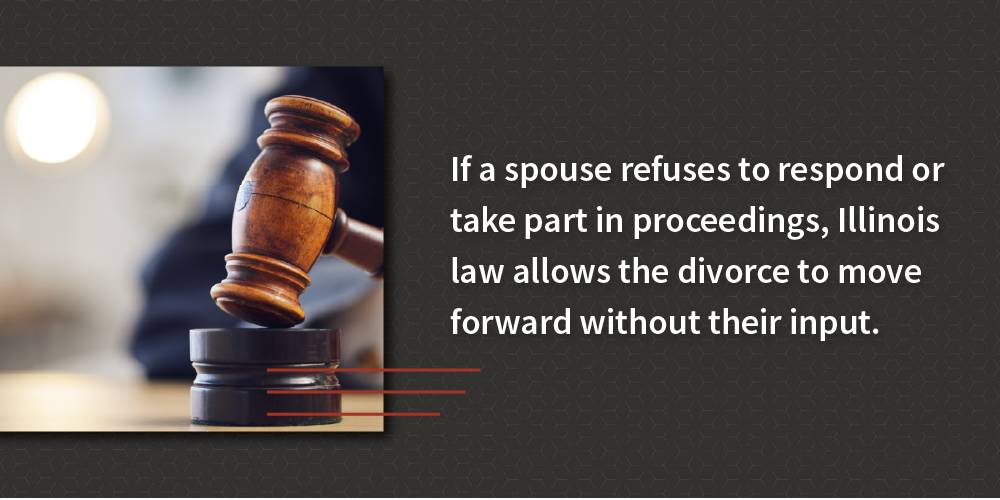
Regardless of the reason, Illinois law does not allow a divorce case to go on forever just because one spouse will not participate. When the respondent fails to take action within the required timeframe, the petitioner may ask the Court to find the respondent in "default."
A default means the respondent has forfeited the right to participate unless the Court allows otherwise. The case does not end automatically, but it moves forward without the respondent’s input.
What Is a Default Divorce in Illinois?
A default divorce can happen when the Court allows the petitioner to proceed without the respondent’s participation. The petitioner must show that service was completed properly and that the respondent failed to respond within the time allowed.
Judges approach default divorces carefully. Courts require proof that the respondent had notice and an opportunity to be heard. Default exists to protect the integrity of the legal process.
Once default is entered, the Court may schedule a prove-up hearing. At that hearing, the petitioner presents testimony and documents supporting the requested divorce terms. The Judge reviews the evidence before entering a final judgment.
When Can Default Divorce Be Used in Illinois?
Default divorce most often appears in cases involving long-term separation or non-cooperation. Common situations include a:
-
Spouse who moved out and severed contact
-
Respondent living out of state who ignores service
-
Spouse struggling with substance abuse or instability
-
Respondent who mistakenly believes silence prevents divorce
Firms with extensive family law experience frequently see default divorces arise in unusual or difficult cases rather than simple, uncontested ones.
How Divorce Terms Are Decided in a Default Case
Default does not mean the petitioner automatically receives everything he or she asks for. Illinois law still governs all outcomes, and the Court must approve final terms.
Judges review the petitioner’s request for arrangements for property division, parental responsibilities, parenting time, child support, and spousal maintenance to make sure they follow Illinois law. Even without opposition, Courts reject terms that appear unfair, unsupported, or illegal.
In practice, default often results in the petitioner receiving most of what he or she asks for, provided the requests are reasonable and supported by the evidence.
Child Custody in Default Divorces
Cases involving children require special care. Illinois Courts prioritize the best interests of the child, regardless of whether only one parent is involved in the divorce. This means starting with the assumption that children will benefit from having a relationship with both parents.
The petitioner can rebut that assumption with evidence about current childcare arrangements. He or she must propose a parenting plan with arrangements for parenting time (visitation) and parental responsibilities (custody). Based on the facts and the child’s best interests, the Judge will approve or modify the petitioner’s parenting plan. Note, however, that a Judge does not have to grant the petitioner sole custody or parenting time simply because the other parent failed to appear.
Property Division and Alimony in Default Divorces
Illinois follows equitable distribution when dividing marital property. A default divorce does not alter that standard. Petitioners must fully disclose assets, debts, income, and expenses. Judges expect honesty and completeness, even when no one challenges the information. Spousal maintenance and child support must follow statutory guidelines.
That being said, if the respondent completely ignores the divorce filing, he or she may end up with far less property and more debt. An unequal division of property that heavily favors the petitioner is a definite possible outcome.
Can You Vacate a Default Judgment
Once entered, a default judgment carries the same legal weight as any other Court order. It becomes final unless it is challenged properly.
Illinois law allows a respondent to ask the Court to vacate a divorce judgment within 30 days per 735 ILCS 5/2-1401. To succeed, the respondent must show both a valid reason for failing to respond and a legal justification for re-opening the case. Judges do not vacate default judgments lightly. Ignoring paperwork without explanation rarely meets the legal standard.
Call a Palatine, IL Divorce Lawyer Today
If your spouse refuses to respond to divorce papers, or if you received divorce documents and feel uncertain about what you should do next, you need a good lawyer. At The Law Office of Nicholas W. Richardson, P.C., our Arlington Heights divorce attorney has many years of experience handling difficult family law cases, including default divorces and other challenging situations.
We offer free consultations and clear explanations so you can make informed decisions. Call 847.873.6741 today.
FREE CONSULTATIONS
|WEEKEND APPOINTMENTS
|TIMELY UPDATES
Call 847.873.6741 for a Free Consultation
Follow Us


The Law Office of Nicholas W. Richardson, P.C. serves clients throughout Illinois from our office in Palatine, including Arlington Heights, Barrington, Bartlett, Buffalo Grove, Des Plaines, Elk Grove Village, Glenview, Hoffman Estates, Inverness, Mt. Prospect, Niles, Prospect Heights, Rolling Meadows, Schaumburg, Skokie, Streamwood, Wheeling, Cook County, DuPage County, Kane County, and McHenry County.
Results listed are not a guarantee or indication of future case results.
© 2026 The Law Office of Nicholas W. Richardson, P.C.
110 N. Brockway St., Suite 220, Palatine, IL 60067
847.873.6741


